
A single broadcast storm can flood an entire office network within seconds, an exhausted IPv4 address pool can leave new devices stranded without a connection, and a poorly planned routing table can turn a simple data request into a slow detour across dozens of unnecessary hops.
Every one of these failures traces back to the same root cause: a network that was never divided into smaller, organized segments. Understanding what is a subnet, and how proper segmentation prevents these exact problems, is the single most practical skill a network administrator, cloud engineer, or curious home user can learn.
Quick Answer Box
A subnet is a smaller, logically divided section of a larger IP network, created to improve routing efficiency, reduce congestion, and isolate traffic. A subnet mask, expressed as a value such as 255.255.255.0 or CIDR notation like /24, tells routers which portion of an IP address identifies the network and which portion identifies the individual device.
Subnet vs IP Address vs Subnet Mask: Quick Comparison
Before exploring the deeper mechanics of what is a subnet in networking, it helps to see how the three core building blocks relate to each other side by side:
| Parameter | Subnet | IP Address | Subnet Mask |
| Primary Function | Divides a large network into smaller, manageable segments | Uniquely identifies a single device on a network | Defines which bits of an IP address belong to the network versus the host |
| Notation Format | CIDR notation, for example 192.168.1.0/24 | Dotted decimal, for example 192.168.1.15 | Dotted decimal or CIDR suffix, for example 255.255.255.0 or /24 |
| OSI Layer | Network Layer (Layer 3) | Network Layer (Layer 3) | Network Layer (Layer 3) |
| Routing Visibility | Visible to routers for traffic segmentation decisions | Visible across the entire routed path | Used internally by routers to calculate the subnet boundary |
| Configuration Purpose | Groups devices, reduces broadcast domains, improves security | Enables communication between two specific devices | Enables the router to determine where one subnet ends and another begins |
What Is a Subnet? Fundamental Definition and Real World Architecture
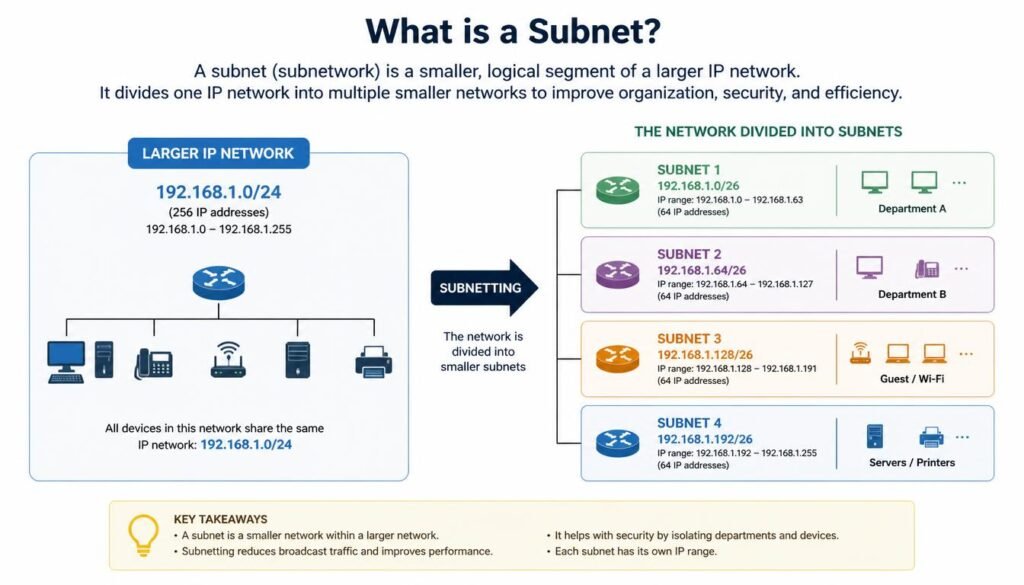
A subnet, short for subnetwork, is a logical subdivision of a larger IP network. When a network administrator applies subnetting, a single large address block is split into several smaller blocks, and each smaller block functions as its own contained segment.
Picture a large corporate office with hundreds of connected devices, printers, servers, and workstations, all sitting on one flat network. Every broadcast message, every device announcement, and every ARP request travels to all of them at once. As the device count grows, this shared traffic load becomes a genuine bottleneck.
Subnetting solves the problem by grouping devices logically, often by department, floor, or function, so that routine traffic stays local and only traffic destined for another segment needs to pass through a router.
This same principle explains what is a subnet in computer networking terms at its most basic level: it is a boundary that keeps unnecessary traffic contained while still allowing controlled communication between segments through routing rules.
Organizations that manage their own network hardware often need to verify how their devices are currently addressed before making any subnetting changes. Reviewing checking local ip configuration settings is a useful first step, since it confirms the exact IPv4 address, subnet mask, and gateway that a device is already using before any segmentation work begins.
How Subnet Masks Work: 255.255.255.0 and CIDR Notation Explained
A subnet mask is the value a router uses to separate the network portion of an IP address from the host portion. Without this mask, a router would have no reliable way to determine what is a subnet address versus what is simply an individual device address.
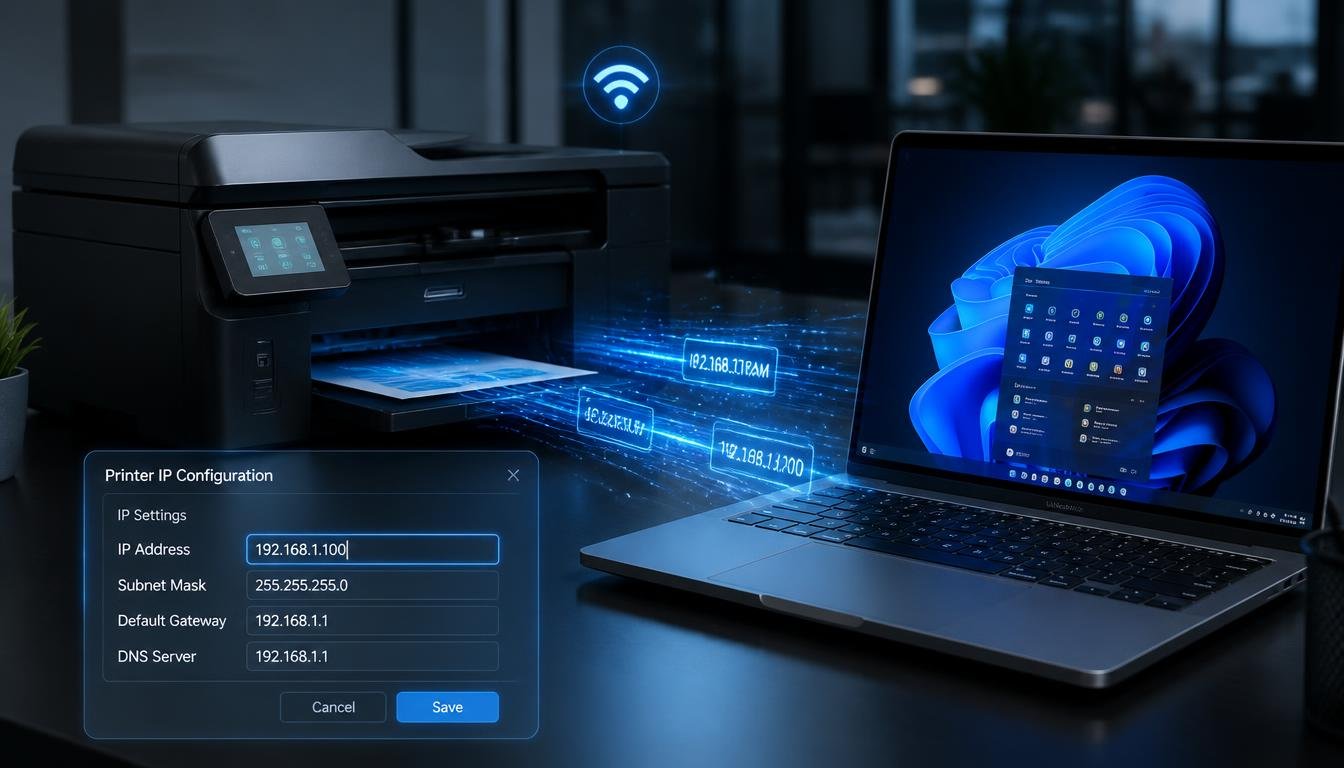
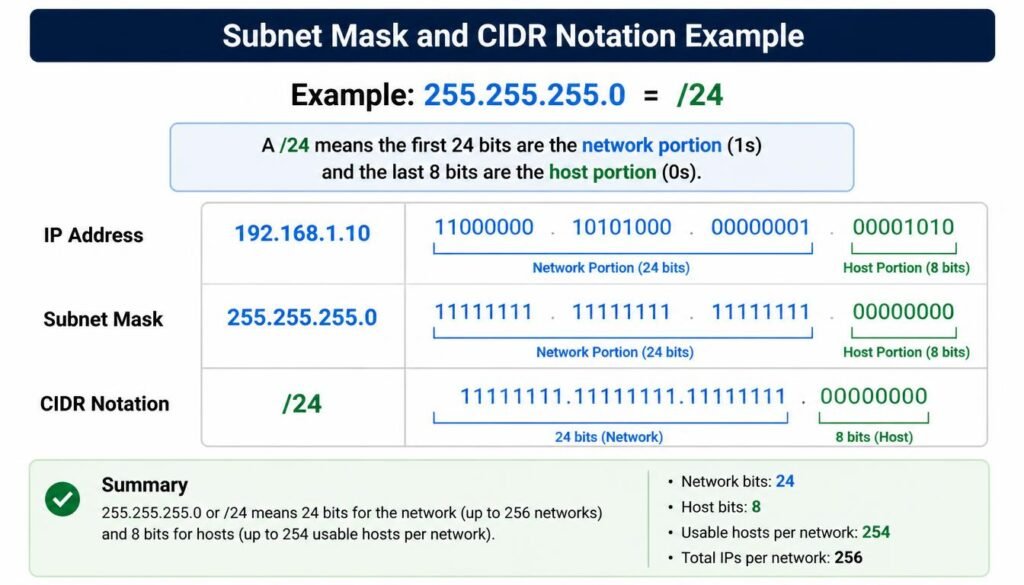
The most common subnet mask, 255.255.255.0, is written in CIDR notation as /24. This means the first 24 bits of the address identify the network, while the remaining 8 bits identify individual devices, allowing for 254 usable host addresses within that segment.
Applying a subnet mask to an IP address uses a binary AND operation. Every bit in the mask that is set to 1 preserves the corresponding bit of the IP address as part of the network identifier, while every bit set to 0 is treated as part of the host identifier.
Common CIDR notations and their host capacity:
- /24 (255.255.255.0): 254 usable host addresses, the standard for most home and small office networks.
- /16 (255.255.0.0): 65,534 usable host addresses, typical for large enterprise deployments.
- /28 (255.255.255.240): 14 usable host addresses, common for small point to point links or isolated device groups.
- /30 (255.255.255.252): 2 usable host addresses, frequently used for router to router connections.
A frequent question users ask is, what does a subnet mask of 255.255.255.0 mean in practical terms. It means the first three octets of the IP address are fixed as the network identifier, and only the final octet varies between individual devices on that specific subnet.
If you are configuring a fixed address on your network, understanding understanding what is static ip alongside your subnet mask ensures the device retains a predictable location within its assigned segment rather than shifting each time the DHCP lease renews.
Is 192.168.1 a Subnet? Clarifying a Common Misconception
The address range 192.168.1.x is not, by itself, a complete subnet definition. It is simply a private address block reserved by the Internet Assigned Numbers Authority for local networks.
It only becomes a functioning subnet once a mask is applied, such as 192.168.1.0/24, which then defines the exact boundary of that network segment and its available host range.
Cloud and Enterprise Subnetting: AWS Public vs Private Subnets
Understanding what is a subnet in AWS requires a slightly different mental model than traditional on-premises networking, although the underlying CIDR mathematics remain identical.
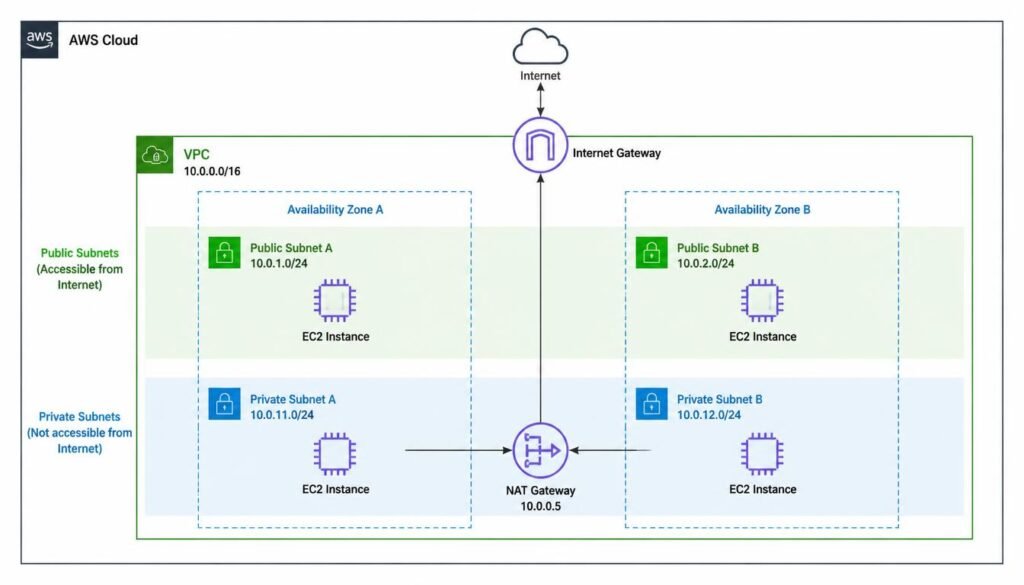
Inside an AWS Virtual Private Cloud (VPC), administrators divide the overall VPC CIDR block into multiple subnets, and each subnet is tied to a specific Availability Zone. This design allows workloads to survive the failure of a single data center location.
- Public Subnets: Configured with a route table entry pointing to an Internet Gateway, allowing resources like web servers or load balancers to receive direct inbound and outbound internet traffic.
- Private Subnets: Contain no direct route to an Internet Gateway. Resources placed here, such as database instances, remain isolated. Outbound access for software updates uses a NAT Gateway sitting in a paired public subnet.
This public and private split is the standard architecture pattern recommended across nearly every AWS Well-Architected deployment, enforcing a clear security boundary without complex firewall rule sets.
For engineers troubleshooting connectivity between local development machines and cloud resources, confirming a stable local connection first through troubleshooting wifi connection issues eliminates local network problems before assuming the issue lies within the VPC subnet configuration itself.
Emerging Technologies: What Is a Subnet in Crypto and Blockchain Ecosystems
The term subnet has expanded well beyond traditional IP networking into blockchain infrastructure, which is where many newer searchers encounter what is a subnet in crypto for the first time.
On the Avalanche blockchain platform, a subnet refers to a customizable, sovereign network of validators that work together to reach consensus on the state of one or more independent blockchains.
Unlike a single monolithic chain that must process every transaction from every application, a blockchain subnet allows developers to launch a dedicated chain with its own rules, validator set, and token economics.
This design solves a scaling problem that closely mirrors IP subnetting: just as a traditional subnet prevents one crowded network segment from congesting an entire organization, a blockchain subnet prevents one high-demand application from congesting transaction throughput across the entire platform.
Practical Step by Step Instructions: How to Find Your Local Subnet
A frequent and highly practical question is, how do I find my subnet on my own computer. The exact method depends on the operating system, but every platform exposes this information through built-in network utilities.
Finding Your Subnet on Windows
- Press Windows Key + R to open the Run dialog box.
- Type cmd and press Enter to launch Command Prompt.
- Type ipconfig /all and press Enter.
- Locate the active network adapter and review the Subnet Mask field listed directly beneath the IPv4 Address.
Finding Your Subnet on macOS
- Open System Settings from the Apple menu.
- Select Network from the left sidebar.
- Click on the active connection, then select Details.
- Open the TCP/IP tab to view the current Subnet Mask alongside the IPv4 address.(Alternatively, open Terminal and type ifconfig to view the mask in hexadecimal format).
Finding Your Subnet on Linux
- Open a terminal window.
- Type ip addr show and press Enter.
- Locate the active interface and review the CIDR suffix listed immediately after the IPv4 address, such as /24.
If a device shows an unexpected result during this process, reviewing viewing saved wifi passwords on windows can help confirm the correct network is selected before reading its subnet details.
Slow response times during diagnostics can sometimes point to deeper connectivity issues. If streaming devices or consoles lag noticeably, fixing slow network performance on gaming consoles addresses the underlying bandwidth bottlenecks that often accompany subnet misconfiguration.
How to Subnet an IP Address: A Worked Example
Subnetting an existing address block by hand follows a repeatable formula once the required number of host addresses is known.
- Identify the required host count: Suppose a department needs support for 50 devices.
- Find the smallest power of two: Calculate $2^x \ge 50 + 2$ (reserving 2 addresses for network ID and broadcast). For 50 hosts, 64 total addresses ($2^6$) is the smallest sufficient block.
- Calculate the CIDR prefix: A block of 64 addresses corresponds to a /26 prefix ($32 – 6 = 26$).
- Determine the subnet mask: A /26 prefix converts to 255.255.255.192.
- List the usable range: For a base network of 192.168.1.0/26, the usable host range spans 192.168.1.1 through 192.168.1.62, with 192.168.1.63 reserved as the broadcast address.
This same method scales to any required host count, forming the basis of what is the subnet mask for 192.168.1.1 24 style calculations frequently searched by students.
If unstable wireless coverage disrupts a device while reconfiguring its address, checking improving weak wifi signal coverage prevents chasing configuration errors that are actually signal drops.
Router administrators making these changes at the network edge should also confirm gateway settings align with new subnet boundaries. Reviewing configuring custom router administration settings ensures the DHCP scope matches the newly calculated subnet range.
Why Subnetting Matters for Network Performance and Security
Beyond the raw mathematics, subnetting delivers three measurable operational benefits that justify the added configuration complexity:
- Reduced Broadcast Traffic: Smaller segments mean broadcast messages reach fewer devices, eliminating network chatter.
- Improved Security Isolation: A compromised device on one subnet cannot directly reach devices on an isolated subnet without passing through firewall rules.
- Efficient Address Allocation: Organizations avoid wasting large blocks of unused IP addresses on departments that only need a handful.
Administrators documenting these configurations across physical spaces often need supporting equipment measurements as well. For teams planning workstation layouts, measuring desktop and laptop screen sizes supports accurate hardware planning during infrastructure rollouts.
Network privacy also becomes relevant once traffic is segmented by subnet. For a clear breakdown of router-level tracking boundaries, checking privacy logs on local wifi connections explains exactly what activity a network owner can observe.
Frequently Asked Questions
What is a subnet in computer?
A subnet in computer networking is a smaller, logically separated segment carved out of a larger IP network. It groups devices together so that local traffic remains contained while a router manages communication between separate subnets.
What is a subnet mask?
A subnet mask is a 32-bit value that identifies which portion of an IP address represents the network and which portion represents the individual device. It is commonly written in dotted decimal format, such as 255.255.255.0, or as a CIDR suffix like /24.
What is a subnet in AWS?
A subnet in AWS is a defined range of IP addresses within a Virtual Private Cloud, tied to a specific Availability Zone. It is configured as either public (with direct internet access through a gateway) or private (isolated from direct inbound internet traffic).
What is a subnet example?
A common subnet example is 192.168.1.0/24, which provides 254 usable host addresses ranging from 192.168.1.1 through 192.168.1.254, with 192.168.1.255 reserved as the broadcast address.
What is a subnet in networking?
In networking, a subnet is the mechanism used to divide one large address space into multiple smaller, independently routed segments. This improves traffic efficiency, simplifies administration, and strengthens security boundaries.
What is a subnet address?
A subnet address, also called the network address, is the first address in a subnet range, always ending in a value that represents an all-zero host portion, such as 192.168.1.0 within a /24 block.
What is a subnet in crypto?
In blockchain platforms such as Avalanche, a subnet in crypto is a customizable network of validators that reaches independent consensus for dedicated blockchains, allowing applications to scale without congesting a single shared chain.
What is a subnet in IP address?
Within an IP address, the subnet portion refers to the network-identifying bits determined by the subnet mask, separating that segment from the host-identifying bits that specify the individual device.
What does a subnet mask of 255.255.255.0 mean?
A subnet mask of 255.255.255.0 means the first three octets of an IP address define the network, while the final octet is reserved for identifying up to 254 individual devices within that specific segment.
Is 192.168.1 a subnet?
No, 192.168.1 alone is not a complete subnet definition. It becomes an actual subnet only when paired with a mask, such as 192.168.1.0/24, which establishes the exact address boundary and usable host range.
What is subnetting in networking?
Subnetting in networking is the process of dividing one larger IP network into multiple smaller subnets. It improves routing efficiency, reduces broadcast domain size, and allows for precise IP address allocation.
How do I find my subnet?
On Windows, run ipconfig /all in Command Prompt. On macOS, open System Settings > Network > Details. On Linux, run ip addr show in a terminal to view the CIDR suffix attached to the active interface.
How to subnet an IP address?
To subnet an IP address, determine the required host count, round up to the nearest power of two plus two reserved addresses, calculate the matching CIDR prefix, and derive the corresponding subnet mask from that prefix length.
What is the subnet mask for 192.168.1.1 24?
A /24 suffix applied to 192.168.1.1 corresponds to a subnet mask of 255.255.255.0, meaning the network is 192.168.1.0 with a usable host range from 192.168.1.1 through 192.168.1.254.
Final Thoughts
Subnetting is the fundamental framework that keeps modern networks structured, secure, and performant. By dividing large IP address blocks into smaller, isolated segments, network administrators can prevent broadcast storms, eliminate traffic congestion, and enforce strict security boundaries across local and cloud environments.
Whether you are configuring a local 192.168.1.0/24 home subnet, setting up AWS VPC public and private subnets, or analyzing subnet masks for certifications, understanding the boundary between network bits and host bits is essential.
Before applying subnet changes across active hardware, always verify your current adapter details using local diagnostics, ensure your router DHCP ranges align with newly calculated subnets, and document your IP assignments to prevent network collisions.
If local network optimization is part of a broader system cleanup, using a windows 11 debloater to safely boost pc speed helps free up background memory and CPU resources required for running complex network analysis tools.
Additionally, if physical connection drops interrupt your subnet testing, reviewing our practical guide on how to boost wifi signal ensures your wireless hardware delivers strong, consistent throughput across all segmented network areas.