What Is Cross-Platform Software? Definition, Examples, and How It Works
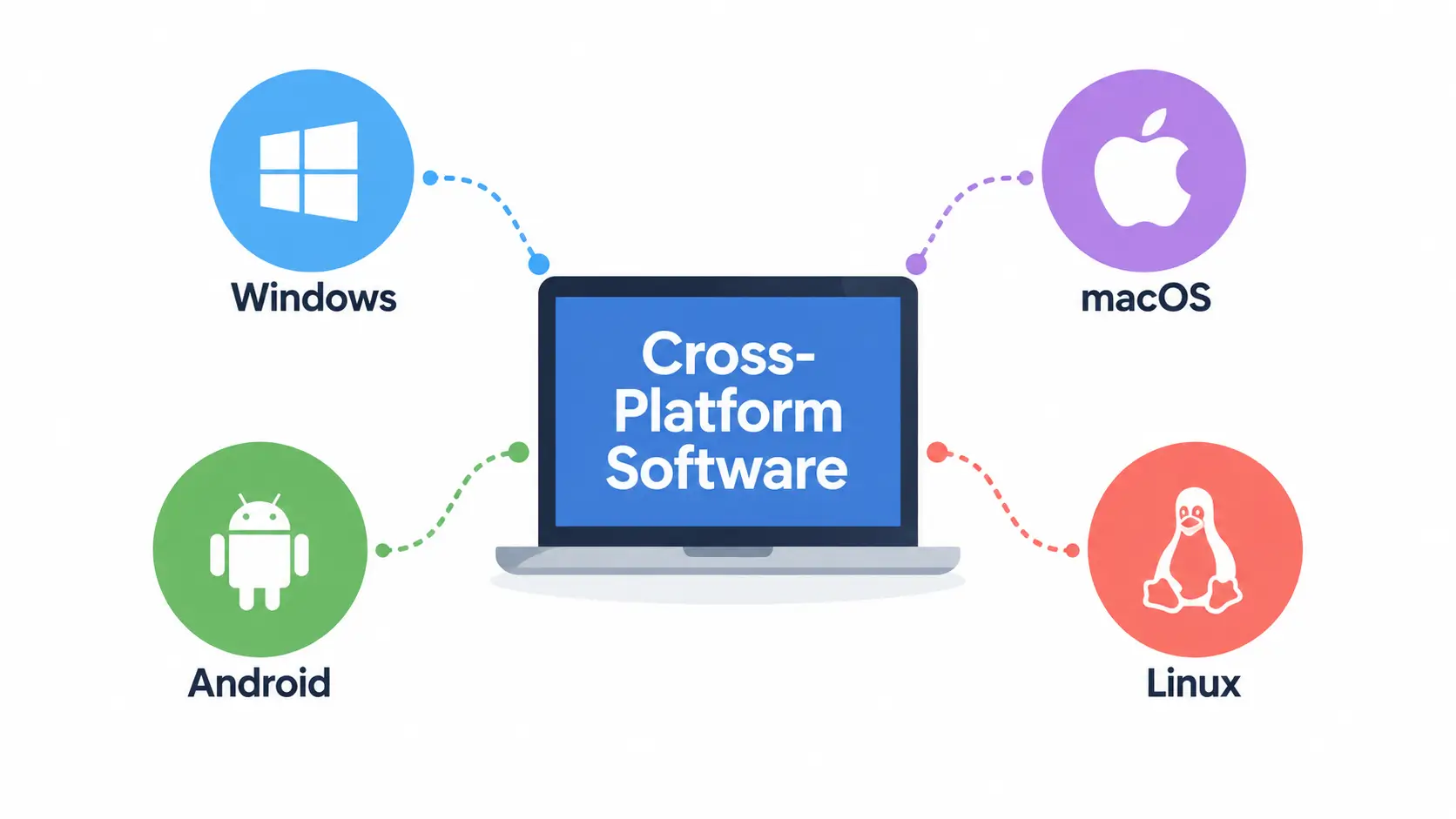
Cross-platform software is a program designed to run on more than one operating system or device platform.
For example, the same type of application may be available on Windows, macOS, Linux, Android, and iOS. Instead of building completely separate software for every platform, developers can reuse a significant portion of the code and adapt it where necessary.
Cross-platform software can reduce development effort, speed up releases, and make it easier to reach users across different devices.
However, cross-platform does not mean that every part of an application is identical on every platform. Developers may still need platform-specific code for features such as hardware access, notifications, permissions, or native user interface behavior.
In this guide, you will learn what cross-platform software means, how it works, its advantages and disadvantages, common examples, development frameworks, and how it compares with native and hybrid software.
What Is Cross-Platform Software?
Cross-platform software is software that can operate across multiple operating systems or computing platforms.
A cross-platform application may support desktop systems such as Windows, macOS, and Linux. A mobile application may target Android and iOS. Some technologies can target desktop, mobile, and web platforms from related codebases.
The main idea is portability.
Developers do not necessarily need to create an entirely separate application from scratch for every operating system. Instead, they can reuse common code, logic, resources, or UI components and add platform-specific implementations when needed.
This approach is useful when an application needs to reach users across several platforms without maintaining completely unrelated software projects.
Here you can read updated info for Adaptive Software Development (ASD)?
What Does Cross-Platform Mean?
The term cross-platform means that software, code, or technology works across multiple platforms.
A platform usually refers to a combination of an operating system, device environment, and related technologies.
Common platforms include:
- Windows
- macOS
- Linux
- Android
- iOS
- iPadOS
- Web browsers
For example, an application that runs on both Windows and macOS can be considered cross-platform.
The term does not mean that the application has exactly the same interface or technical implementation everywhere. Platform differences can still affect how software behaves.
What Is Cross-Platform Software Development?
Cross-platform software development is the process of creating software for multiple platforms while reusing as much development work as practical.
Developers commonly use frameworks, libraries, programming languages, runtimes, APIs, and abstraction layers to achieve this.
For example, .NET MAUI lets developers create native mobile and desktop applications for Android, iOS, macOS, and Windows from a shared codebase.
Flutter takes a similar multi-platform approach and supports building, testing, and deploying applications from a single codebase.
The important distinction is simple:
Cross-platform software is the finished program.
Cross-platform development is the process used to build software for multiple platforms.
How Does Cross-Platform Software Work?
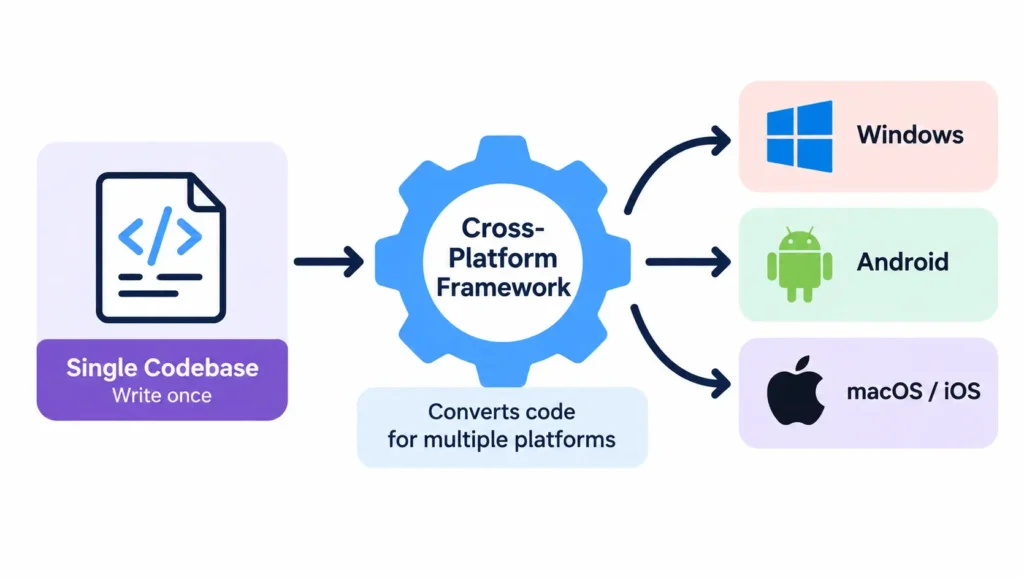
Cross-platform software works by reducing the differences between target platforms through shared code, frameworks, runtimes, APIs, and platform-specific components.
The exact architecture depends on the technology being used.
A simplified process looks like this:
Shared source code → cross-platform framework or runtime → platform integration → platform-specific build → application
Not every application follows this exact architecture.
Some technologies compile code into native binaries. Others use a runtime, rendering engine, web technologies, or shared libraries.
Shared or Reusable Code
One of the biggest ideas behind cross-platform development is code reuse.
Instead of maintaining completely separate implementations for every operating system, developers can share common application logic.
This may include:
- Business logic
- Data models
- Networking
- Authentication
- Validation
- API communication
- Database logic
- Application state
- Testing code
- UI components
The amount of reusable code depends on the framework and application.
A simple application may share a large portion of its code. A complex application with deep hardware integration may require more platform-specific implementation.
Frameworks and Runtimes
Frameworks provide developers with tools and APIs that simplify multi-platform development.
For example:
- Flutter provides a multi-platform application framework.
- React Native uses JavaScript and React concepts while rendering native platform UI.
- .NET MAUI provides a cross-platform UI framework using C# and XAML.
- Kotlin Multiplatform allows developers to share Kotlin code while retaining the ability to use native implementations.
- Electron uses web technologies with Chromium and Node.js to build desktop applications.
React Native describes its approach as creating native applications for Android, iOS, and other platforms using React. Its components map to native platform UI elements.
Electron takes a different approach. It combines HTML, CSS, JavaScript, Chromium, and Node.js to build desktop applications for Windows, macOS, and Linux.
Abstraction Layers
An abstraction layer hides some platform-specific details behind a common interface.
For example, an application may need to access a device feature such as:
- Camera
- File system
- Location
- Network
- Notifications
- Sensors
- Secure storage
Instead of writing completely different application logic for each operating system, a framework can provide a common API.
The framework then handles much of the platform-specific work underneath.
.NET MAUI, for example, provides cross-platform APIs while still allowing developers to access platform-specific APIs when necessary.
Platform-Specific Components
Cross-platform development does not eliminate native development.
Some features behave differently on Windows, Android, iOS, or macOS.
Developers may therefore create platform-specific code for:
- Native APIs
- Hardware features
- Permissions
- Push notifications
- File handling
- System integrations
- Performance-critical features
- Platform-specific UI behavior
This is an important point because cross-platform does not mean write once and never touch platform-specific code.
Modern frameworks are designed to make sharing easier while still providing access to native functionality when required.
For example, .NET MAUI includes platform-specific folders and APIs for scenarios where shared code is not enough.
If you want to learn Best Free Drawing Software visit this link.
What Are Examples of Cross-Platform Software?
Many types of applications can be cross-platform.
Common examples include:
- Web browsers
- Media players
- Code editors
- Productivity applications
- Communication tools
- Development tools
- Business applications
- Cloud-connected applications
Web Browsers
Web browsers are a familiar example of software distributed across multiple operating systems.
For instance, users can install browsers on different desktop operating systems rather than needing a completely unrelated browser experience for each one.
Media Players
VLC is a well-known example.
VideoLAN describes VLC as a free, open-source, cross-platform multimedia player. Current official downloads include Windows, macOS, Linux, Android, and other supported systems.
This makes VLC an easy real-world example of cross-platform software.
Productivity Software
Productivity applications can also target multiple platforms.
A note-taking, document, project management, or communication application may provide desktop and mobile versions while sharing backend services and some application logic.
The user may therefore access the same service from different devices.
Communication Applications
Messaging and collaboration software often needs to reach users across several platforms.
A company may provide:
- Windows application
- macOS application
- Linux application
- Android application
- iOS application
- Web application
The implementations can differ, but the core service and functionality can remain closely connected.
What Are the Benefits of Cross-Platform Software?
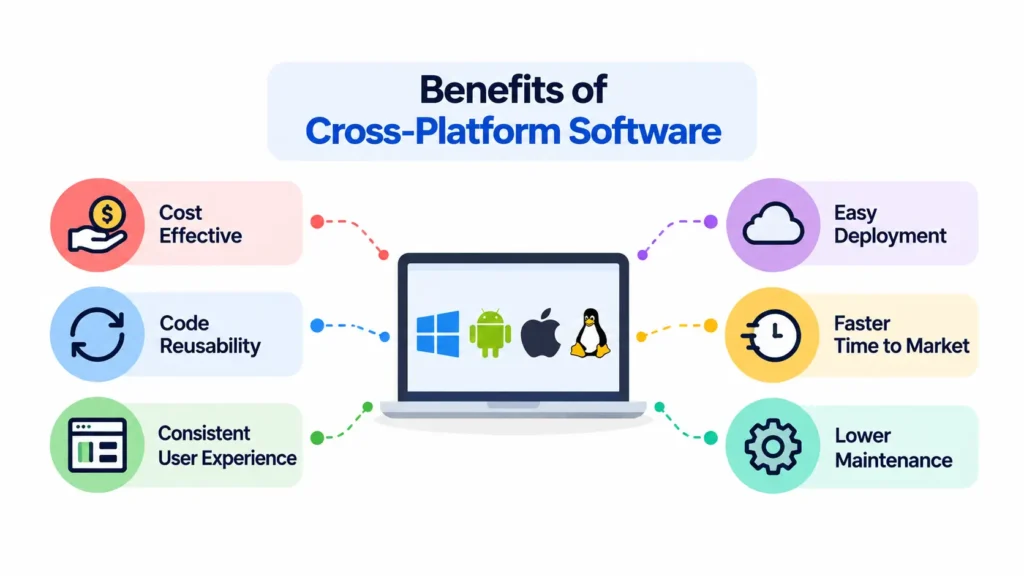
Cross-platform software can provide several important benefits for developers, businesses, and users.
The biggest advantage is usually the ability to support multiple platforms without completely duplicating development work.
Reusable Code
Shared code can reduce duplicate development.
If application logic works across several platforms, developers can maintain one common implementation instead of maintaining unrelated versions.
This can simplify:
- Bug fixes
- Feature development
- Testing
- Code review
- Maintenance
The exact amount of reuse depends on the project.
Lower Development Effort
Building separate native applications can require different teams, tools, architectures, and testing processes.
A cross-platform approach can reduce some of that duplication.
This can be especially valuable for smaller teams that need to support several operating systems.
Faster Development
Reusable components can help developers build and release applications more quickly.
A shared codebase can also make it easier to introduce the same business logic or feature across several platforms.
However, development speed depends on the application and framework.
Complex platform-specific requirements can reduce the time savings.
Wider Platform Reach
Cross-platform development can help software reach more users.
A company can target several operating systems without building completely separate applications from the ground up.
This is particularly useful for products where users are spread across desktop and mobile environments.
Easier Maintenance
A well-structured shared codebase can simplify maintenance.
For example, a security fix in shared application logic may only need to be implemented once before being included in multiple platform builds.
Developers must still test each supported platform because platform-specific behavior can introduce different bugs.
Consistent Features Across Platforms
Cross-platform development can make it easier to provide similar functionality across different devices.
Users may expect the same:
- Account
- Data
- Settings
- Features
- Workflow
- Application behavior
on different devices.
Shared code and backend services can help maintain that consistency.
What Are the Disadvantages of Cross-Platform Software?
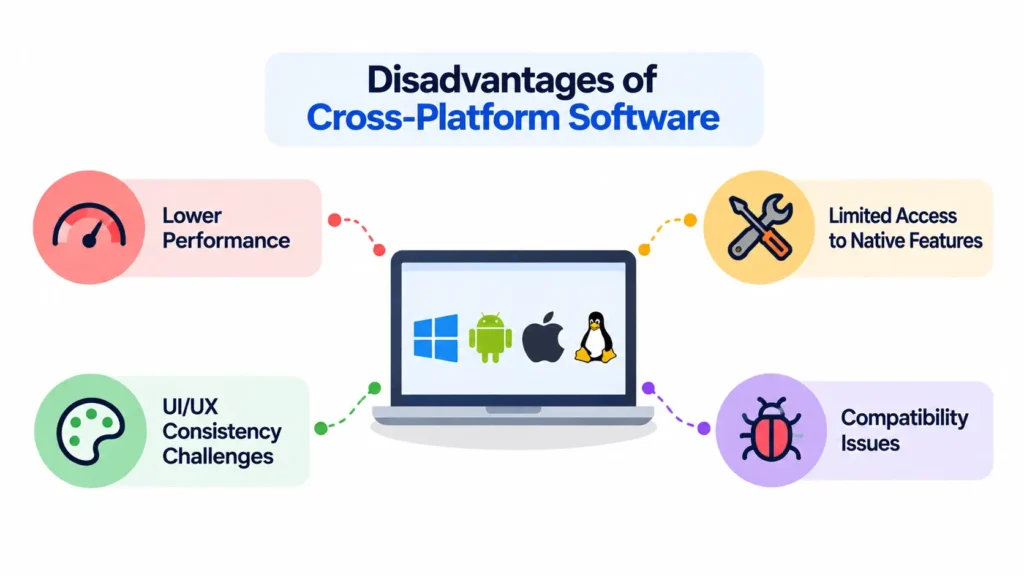
Cross-platform software is not automatically the best solution for every project.
It can introduce tradeoffs involving performance, UI behavior, platform APIs, testing, and framework dependencies.
Platform-Specific Differences
Windows, macOS, Android, and iOS do not work in exactly the same way.
They have different:
- APIs
- Permission models
- File systems
- Hardware
- UI conventions
- App distribution systems
- Background processing rules
A cross-platform framework must account for these differences.
Performance Considerations
Cross-platform applications can provide strong performance, but performance depends heavily on the architecture.
A framework that produces native code may behave differently from an application that relies heavily on an additional runtime or rendering layer.
Performance-sensitive software may therefore require deeper platform-specific optimization.
User Interface Differences
Users expect applications to follow familiar conventions on their platform.
A navigation pattern that feels natural on Android may not feel equally natural on iOS.
Developers must decide whether to create:
- One consistent UI
- Adaptive UI
- Platform-specific UI
- A combination of shared and native components
A good cross-platform application should balance consistency with platform expectations.
Native Feature Limitations
Some platform features may not be equally supported by a framework.
Developers may need plugins, extensions, native APIs, or custom platform-specific code.
Flutter’s documentation, for example, explains that developers can integrate platform-specific functionality and write platform-specific code when necessary.
Testing Across Multiple Platforms
Supporting more platforms also increases the testing surface.
An application may need testing across:
- Different operating systems
- Different screen sizes
- Different processors
- Different browsers
- Different OS versions
- Different hardware configurations
A feature that works correctly on Windows may still fail on macOS.
Framework Dependency
Cross-platform applications often depend on the framework and its ecosystem.
Developers must consider:
- Framework updates
- Package compatibility
- Security updates
- Community support
- Documentation
- Platform support
- Migration requirements
Choosing a mature framework can reduce some of these risks.
What Is Cross-Platform Software Development?
Cross-platform software development is a structured process for creating software that targets multiple platforms.
A typical workflow looks like this:
Plan → Build shared code → Add platform features → Test → Deploy → Maintain
How Developers Build Cross-Platform Applications
1. Define the Target Platforms
Developers first decide where the application needs to run.
For example:
- Windows
- macOS
- Linux
- Android
- iOS
- Web
The target platforms influence technology and architecture.
2. Choose a Development Approach
The team then chooses a suitable technology.
Possible choices include:
- Flutter
- React Native
- .NET MAUI
- Kotlin Multiplatform
- Electron
- Other cross-platform frameworks
The right choice depends on the application type, team skills, platform requirements, and performance needs.
3. Build Shared Application Logic
Developers create reusable components such as business rules, networking, data handling, and application state.
This is where much of the potential efficiency comes from.
4. Integrate Platform Features
Native functionality is added where necessary.
For example, a mobile application might need access to:
- Camera
- GPS
- Bluetooth
- Biometrics
- Notifications
- Local storage
The developer may use a cross-platform API or platform-specific implementation.
5. Test Each Platform
The application is tested on every supported platform.
This step is essential because shared code does not guarantee identical behavior.
6. Build and Deploy
The project is then packaged for its target platforms.
The final result may include separate installation packages for each operating system.
7. Maintain the Application
Developers continue updating the shared code, dependencies, platform integrations, and individual builds.
Cross-platform development reduces duplicated work, but it does not remove the need for ongoing maintenance.
What Technologies Are Used for Cross-Platform Development?
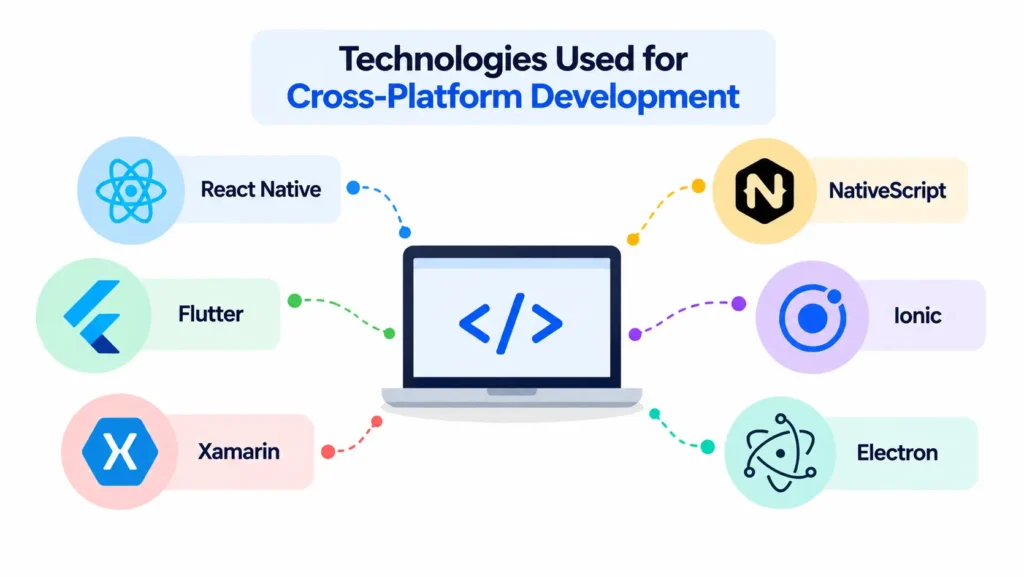
Several frameworks and technologies can be used to build cross-platform applications.
The best option depends on the type of software being developed.
Flutter
Flutter is Google’s UI toolkit for building multi-platform applications.
Its documentation describes Flutter as a technology for building, testing, and deploying multi-platform applications from a single codebase. It supports targets including Android, iOS, web, Windows, and macOS.
Flutter is commonly associated with:
- Dart
- Shared UI
- Mobile applications
- Desktop applications
- Web applications
- Custom interfaces
It can also integrate with platform-specific functionality when required.
React Native
React Native is a popular framework for building mobile applications with React and JavaScript.
It provides platform-agnostic components that map to native UI building blocks.
This lets developers reuse application code while still producing applications that interact with native platform APIs.
React Native is particularly relevant for teams already familiar with:
- JavaScript
- React
- TypeScript
- Web development
.NET MAUI
.NET MAUI stands for .NET Multi-platform App UI.
It is Microsoft’s cross-platform framework for creating native mobile and desktop applications with C# and XAML.
Microsoft states that .NET MAUI can target Android, iOS, macOS, and Windows from a shared codebase.
It is especially relevant for developers working within the .NET ecosystem.
Kotlin Multiplatform
Kotlin Multiplatform, developed by JetBrains, focuses on sharing code across platforms while allowing developers to retain native implementations where appropriate.
This makes it different from approaches that require every part of an application to use one identical implementation.
JetBrains describes Kotlin Multiplatform as allowing teams to reuse as much code as they want while still writing native code when needed.
This flexibility can be useful for teams that want to share business logic while maintaining platform-specific user interfaces.
Electron
Electron is mainly used for desktop software.
It combines:
- JavaScript
- HTML
- CSS
- Chromium
- Node.js
Electron allows developers to create desktop applications for Windows, macOS, and Linux from a JavaScript codebase.
This makes it a common choice for teams with strong web development experience.
Is Python Cross-Platform?
Yes, Python is generally considered a cross-platform programming language.
Python programs can run on multiple operating systems when Python and the required dependencies are available for those systems.
Python’s standard library includes platform-neutral APIs designed to improve portability.
However, Python code is not automatically platform-independent in every situation.
For example, code that relies on a Windows-specific module or operating system behavior may not work on Linux or macOS without changes.
Python’s own documentation notes that some standard-library modules are platform-specific. For example, winreg is available only on Windows.
So the better answer is:
Python is cross-platform, but individual Python programs may contain platform-specific code.
Cross-Platform vs Native Software
Cross-platform and native software use different development strategies.
| Feature | Cross-Platform Software | Native Software |
| Target | Multiple platforms | Usually one platform |
| Code reuse | High potential | Usually lower across platforms |
| Development effort | Often lower for multiple platforms | Higher when supporting many platforms |
| Performance | Can be excellent, depending on technology | Usually optimized for the target platform |
| Native APIs | Available through frameworks or integrations | Direct access |
| UI approach | Shared, adaptive, or platform-specific | Designed specifically for the platform |
| Maintenance | Shared logic can simplify maintenance | Separate codebases may require more work |
| Best for | Broad platform coverage | Deep platform optimization |
Native development can be the better choice when an application depends heavily on one platform’s APIs, hardware, or design conventions.
Cross-platform development is often attractive when broad reach and code reuse are major priorities.
Cross-Platform vs Hybrid Software
Cross-platform and hybrid software are related, but they are not identical terms.
Cross-Platform Software
Cross-platform is a broad category.
It describes software that works across multiple platforms.
The underlying implementation can use different approaches.
For example, a cross-platform application might use:
- Native components
- Shared code
- A compiled framework
- A runtime
- Web technologies
- Platform-specific integrations
Hybrid Software
Hybrid applications are a more specific approach.
Hybrid apps commonly use web technologies such as HTML, CSS, and JavaScript for their interface and package that UI inside a native application container.
Microsoft describes hybrid apps as a blend of native and web technologies that can access device capabilities through the native application layer.
Are They the Same?
No.
Hybrid software can be cross-platform, but not all cross-platform software is hybrid.
For example, a native-rendered application created with React Native or .NET MAUI can be cross-platform without being a traditional web-wrapper hybrid application.
Cross-Platform vs Platform-Independent Software
These terms are closely related, but they should not be treated as perfect synonyms.
Cross-platform usually means software is designed or implemented to work across multiple platforms.
Platform-independent suggests that the software has little or no dependence on a specific platform.
A Python application that uses platform-neutral APIs may be highly portable.
But if that same application depends on Windows-only functionality, it becomes less platform-independent.
In practice, most real-world software has some level of platform dependency.
Cross-Platform Software vs Cross-Platform Development
The difference is simple:
| Term | Meaning |
| Cross-platform software | Finished software that runs on multiple platforms |
| Cross-platform development | The process of creating software for multiple platforms |
| Cross-platform framework | Technology that helps developers build for multiple platforms |
| Cross-platform code | Code designed to work across supported platforms |
For example, VLC is cross-platform software.
Flutter is a cross-platform development framework.
A developer using Flutter to build an application is doing cross-platform software development.
Keeping these concepts separate makes the terminology much easier to understand.
Is Cross-Platform Software the Same as Cross-Platform Gaming?
No.
Cross-platform software is a broad software-development concept.
Cross-platform gaming usually refers to games that support multiple gaming platforms. A related term, cross-play, describes the ability for players on different platforms to play together.
For example, a game might support:
- PC
- PlayStation
- Xbox
- Nintendo Switch
If players on those platforms can play together, that is a cross-play feature.
Other gaming concepts include:
- Cross-save
- Cross-progression
- Cross-platform accounts
- Cross-platform purchases
These concepts are related to gaming ecosystems rather than the general definition of cross-platform software.
What Is a Simple Example of Cross-Platform Software?
VLC is a simple real-world example.
You can use VLC across operating systems such as Windows, macOS, Linux, Android, and iOS. VideoLAN identifies VLC as cross-platform software and provides downloads for multiple operating systems.
A simplified example would be:
Imagine a company creates a note-taking application.
Instead of creating five completely separate applications, developers share the application’s:
- Note storage logic
- User authentication
- Search functionality
- Synchronization
- Business rules
They then adapt the application for Windows, macOS, Android, and iOS.
That application would be a cross-platform application.
When Should You Use Cross-Platform Software Development?
Cross-platform development can be a strong choice when your product needs to reach users on several platforms.
It is particularly useful when:
- You have a small or medium development team.
- You need mobile apps for Android and iOS.
- You need desktop apps for multiple operating systems.
- Much of the application logic can be shared.
- Consistent functionality matters.
- Development speed is important.
- You want to reduce duplicated development work.
- Your team already knows a suitable cross-platform technology.
It can also be useful for business applications where the same workflows need to be available across different devices.
When Is Native Development Better?
Native development may be better when the application depends heavily on a particular platform.
Consider native development when you need:
- Maximum platform-specific performance
- Deep hardware integration
- Advanced graphics
- Specialized operating system APIs
- Highly customized native UI
- Immediate access to new platform features
- Platform-specific user experiences
For example, a highly specialized iOS application may benefit from a native Apple development approach.
Likewise, a Windows application that depends heavily on Windows-specific APIs may be better suited to native Windows technologies.
The correct choice depends on the product rather than the popularity of a framework.
Frequently Asked Questions About Cross-Platform Software
What does cross-platform mean?
Cross-platform means that software or technology works across multiple operating systems, devices, or computing environments.
Can you give me an example of cross-platform software?
VLC is a common example. It is a cross-platform media player available across several operating systems, including Windows, macOS, Linux, Android, and iOS.
What are some examples of cross-platform applications?
Examples include VLC and applications built with technologies such as Flutter, React Native, .NET MAUI, Electron, and Kotlin Multiplatform.
The exact platforms supported depend on the application and technology.
How does cross-platform software work?
Cross-platform software commonly works by sharing code across platforms and using frameworks, runtimes, APIs, or abstraction layers to handle platform differences.
Developers can also add platform-specific code when required.
What is cross-platform software development?
Cross-platform software development is the process of creating applications that target multiple platforms while reusing as much code and development work as practical.
Is Python cross-platform?
Yes. Python supports multiple operating systems, and its standard library includes APIs designed to improve portability. However, Python programs can still contain platform-specific code.
Is cross-platform software the same as native software?
No.
Cross-platform software targets multiple platforms using shared or reusable development components. Native software is designed specifically for a particular platform.
Is cross-platform software the same as hybrid software?
No.
Hybrid software is one approach to building applications that can work across platforms. Cross-platform software is the broader concept.
Is cross-platform software platform-independent?
Not necessarily.
Cross-platform software can still depend on platform-specific APIs, libraries, hardware, or operating system behavior.
What are the advantages of cross-platform software?
The main advantages include code reuse, reduced development duplication, broader platform reach, faster development, and potentially simpler maintenance.
What are the disadvantages of cross-platform software?
Potential disadvantages include platform-specific limitations, framework dependencies, additional testing requirements, UI differences, and the need for native code in some scenarios.
Final Takeaway
Cross-platform software is software designed to work across multiple operating systems or device platforms.
Its main advantage is reusability. Developers can share application logic, UI components, business rules, and other code instead of creating completely separate software for every platform.
Technologies such as Flutter, React Native, .NET MAUI, Kotlin Multiplatform, and Electron provide different ways to achieve this goal.
But cross-platform does not mean that every platform behaves identically.
A strong cross-platform application combines shared code with platform-aware design, testing, and native integrations where necessary.
In simple terms:
Cross-platform software lets one software product reach users across multiple platforms while allowing developers to reuse a significant amount of their development work.
That balance between code reuse, platform reach, performance, and native functionality is what makes cross-platform development useful for modern software projects.