What Is Adaptive Software Development (ASD)? How It Works, Phases & Benefits
Software projects do not always go according to plan. Requirements change, customers discover new needs, and technical problems can appear during development.
Adaptive Software Development (ASD) is an Agile software development methodology designed for this kind of uncertainty. It helps teams treat change as a normal part of development instead of something that must be avoided.
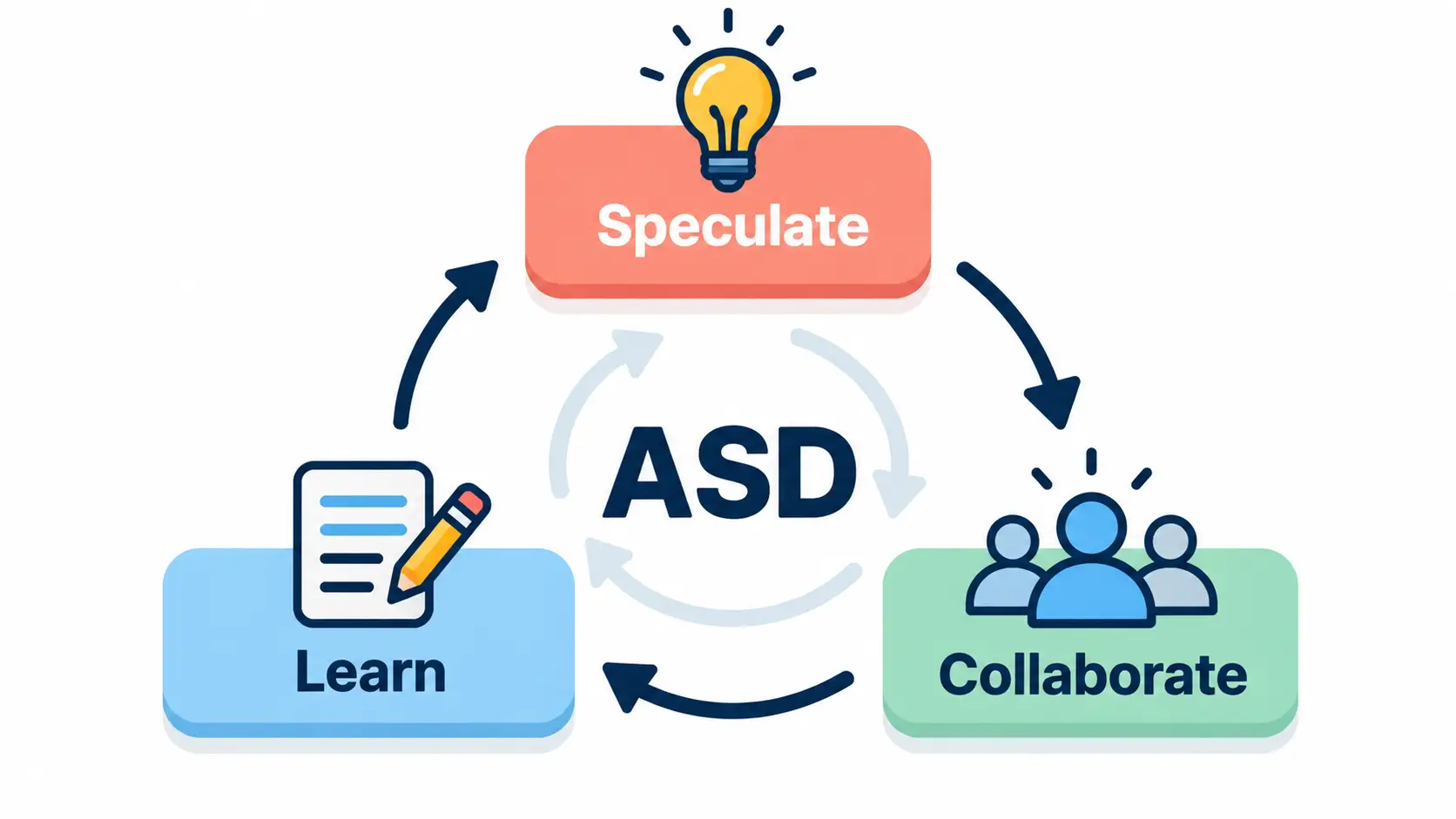
ASD uses a repeating cycle of Speculate, Collaborate, and Learn. Teams set a direction, work together, review what they build, and adapt the next cycle based on new information.
This guide explains what ASD means, how it works, its three phases, benefits, limitations, real-world examples, and how it compares with Agile, Scrum, Kanban, and Waterfall.
What Is Adaptive Software Development?
Adaptive Software Development is an Agile methodology for building software when requirements, priorities, and technical knowledge may change during a project.
Instead of creating one detailed plan and following it from beginning to end, ASD uses flexible planning and repeated feedback.
The team starts with a broad mission and makes reasonable assumptions about the work. It then collaborates to build software and learns from testing, customer feedback, and real results.
That learning influences the next development cycle.
This creates a continuous loop:
Speculate → Collaborate → Learn → Adapt → Repeat
The approach grew from the work of Jim Highsmith and Sam Bayer on rapid application development in the 1990s. Highsmith later published Adaptive Software Development: A Collaborative Approach to Managing Complex Systems, which formally developed the approach and its ideas around uncertainty, collaboration, and iterative change.
What Does ASD Stand For?
ASD stands for Adaptive Software Development.
It describes a software development approach that expects change and uncertainty instead of assuming that every requirement can be known at the beginning.
The word adaptive is important.
The team does not simply adapt the finished product. It can also adapt its plans, priorities, development practices, and understanding of the problem as the project evolves.
Who Created Adaptive Software Development?
Adaptive Software Development is closely associated with Jim Highsmith and Sam Bayer.
Their work grew from rapid application development practices during the 1990s. The approach was intended for complex projects where high speed, changing requirements, and uncertainty made rigid planning difficult.
Jim Highsmith later became one of the contributors to the Agile movement and was a coauthor of the Agile Manifesto.
Here you also read this new Best Free Drawing Software.
How Does Adaptive Software Development Work?
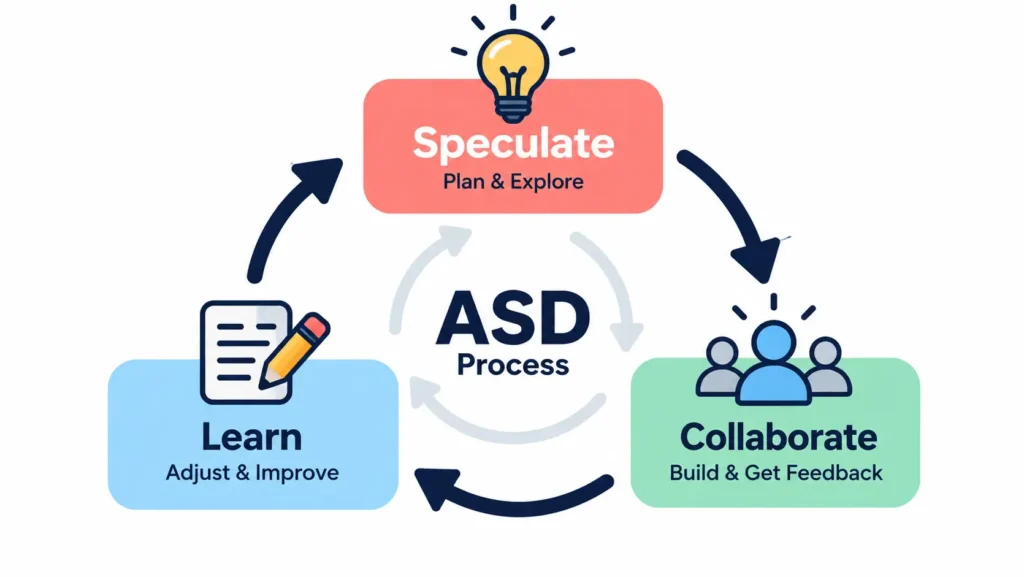
ASD works through short, repeating development cycles.
The team does not assume that the original plan will remain correct forever. Instead, each cycle produces new information that can change what the team does next.
A typical cycle looks like this:
- Speculate: Set a direction and make an initial plan.
- Collaborate: Build and solve problems together.
- Learn: Review results and discover what needs to change.
- Adapt: Use those lessons to shape the next cycle.
The process then repeats.
This makes ASD different from a development process that expects requirements and solutions to remain stable from the beginning.
Planning still matters. The difference is that the plan is treated as something that can evolve.
Atlassian describes ASD as an approach where teams continuously refine their work through feedback and measure progress through usable software and validated learning.
What Are the Three Phases of Adaptive Software Development?
The three core phases are:
Speculate → Collaborate → Learn
These phases are not intended to happen only once. They form a repeating cycle.
1. Speculate
The first phase is Speculate.
The team creates a broad direction for the project instead of pretending it can predict every detail.
During this phase, the team may:
- Define the project mission
- Identify major goals
- Estimate an initial release direction
- Identify important features
- Consider risks
- Make assumptions about user needs
- Create an initial development plan
The term “speculate” does not mean randomly guessing.
It recognizes that some information is unavailable at the beginning.
The team makes informed assumptions while accepting that some of those assumptions may later prove wrong.
This is an important part of adaptive planning.
2. Collaborate
The second phase is Collaborate.
Developers, customers, managers, testers, designers, and other stakeholders work together to turn the project’s direction into working software.
Collaboration helps teams share knowledge and discover problems earlier.
It can include:
- Technical discussions
- Customer feedback
- Design decisions
- Pair or group problem solving
- Testing
- Knowledge sharing
- Feature development
- Review sessions
ASD places strong importance on collaboration because complex problems are rarely solved well by one person working in isolation.
The original ASD work also emphasizes collaboration at interpersonal, cultural, and structural levels.
3. Learn
The third phase is Learn.
The team examines what happened during the development cycle.
It asks questions such as:
- Did the feature solve the user’s problem?
- Were our assumptions correct?
- What did testing reveal?
- What did customers dislike?
- What technical problems appeared?
- What should we change next?
Learning can come from prototypes, customer reviews, software inspections, testing, and project retrospectives.
The important point is that the team uses real information to improve the next cycle.
The original ASD material explicitly connects its learning model with techniques such as customer reviews, software inspections, and project postmortems.
The ASD Cycle at a Glance
| Phase | Main Purpose | Typical Question |
| Speculate | Set direction | What do we think we need to build? |
| Collaborate | Build together | How can we solve the problem as a team? |
| Learn | Review and improve | What did we discover from this cycle? |
The cycle then starts again with a better understanding of the project.
What Are the Principles of Adaptive Software Development?
ASD is built around several ideas that help teams work in uncertain environments.
Accept Change
Requirements can change as users understand their needs better.
ASD treats this change as information rather than automatically treating it as project failure.
Work With Uncertainty
Teams may not know the complete solution at the beginning.
ASD allows them to make informed assumptions and improve their understanding through development.
Encourage Collaboration
Complex software requires different types of knowledge.
Developers, customers, testers, managers, and other stakeholders need opportunities to share that knowledge.
Learn From Feedback
Working software provides information that plans alone cannot provide.
Teams can use testing and customer feedback to discover whether their assumptions were correct.
Deliver in Iterations
Instead of waiting until the entire project is complete, teams work through repeated cycles.
Each cycle creates an opportunity to evaluate progress.
Adapt the Plan
A plan created at the beginning of a project may become less useful as new information appears.
ASD allows the team to change direction when evidence supports doing so.
These ideas closely align with broader Agile values around collaboration, working software, and responding to change.
Adaptive Software Development Example
A simple example makes ASD much easier to understand.
Imagine a company is building a food delivery application.
The team knows it needs an application where customers can browse restaurants, order food, and track deliveries.
However, it does not know exactly which features users will value most.
Speculate
The team defines the initial mission.
It decides to build:
- Restaurant listings
- Food menus
- Ordering
- Basic delivery tracking
The team creates an initial release plan.
It understands that some assumptions may change.
Collaborate
Developers, designers, product managers, restaurant owners, and customers work together.
The team builds an early version of the application.
Users begin testing the product.
Learn
The team discovers something unexpected.
Users find restaurant filtering more important than the team originally expected.
They also find the delivery tracking interface confusing.
The team now has new information.
Adapt
The next development cycle changes.
The team improves restaurant filtering and redesigns delivery tracking.
The original plan has changed, but that is not necessarily a failure.
The team learned something valuable before investing too much time in the wrong direction.
That is the central idea behind adaptive development.
Why Is Adaptive Software Development Useful?
ASD is useful when a project contains significant uncertainty.
For example, a company may know the problem it wants to solve but not know exactly what the final product should look like.
Customer expectations may change.
Technology may introduce unexpected challenges.
Competitors may change the market.
Testing may reveal that an important assumption was wrong.
A rigid plan can struggle in these situations.
An adaptive approach gives the team a structured way to respond.
ASD can help teams:
- Respond to changing requirements
- Use customer feedback
- Discover technical problems earlier
- Improve collaboration
- Learn from working software
- Adjust priorities
- Reduce the risk of following an incorrect assumption for too long
It does not eliminate uncertainty.
Instead, it gives the team a way to work with it.
What Are the Advantages of Adaptive Software Development?
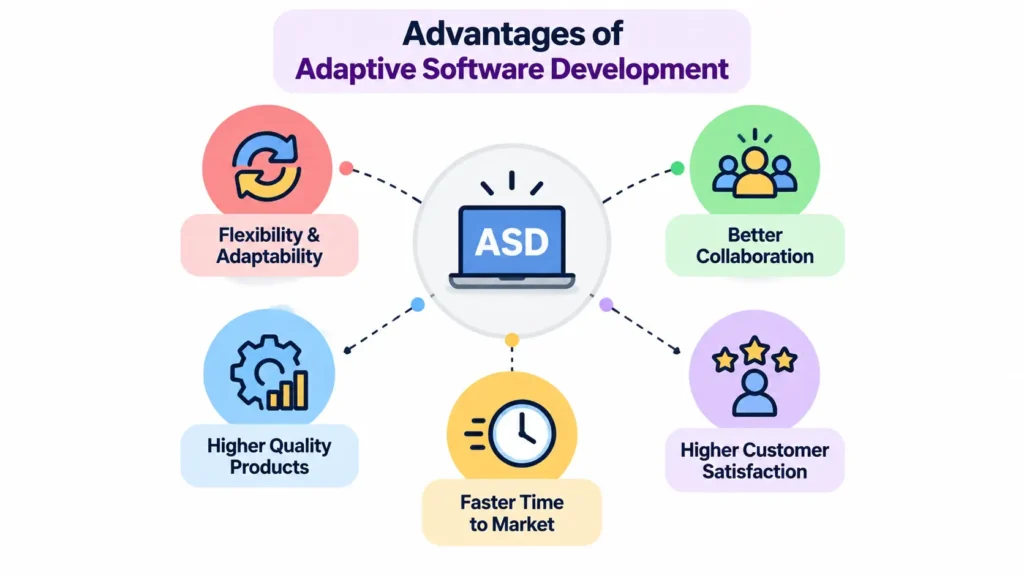
Responds to Changing Requirements
ASD expects requirements to evolve.
This can be useful when users are still discovering what they need.
Encourages Customer Involvement
Regular feedback helps teams understand whether the product is solving the intended problem.
Finds Problems Earlier
Frequent development and review can expose technical or product problems before they become deeply embedded.
Supports Continuous Learning
Every development cycle can provide new information.
Teams can use that information to improve future decisions.
Improves Team Collaboration
ASD encourages people with different skills to work together.
This can improve communication and shared understanding.
Reduces the Risk of Following a Wrong Plan
A detailed plan can still be wrong.
ASD reduces the danger of following incorrect assumptions for an extended period because teams repeatedly review their results.
What Are the Disadvantages of Adaptive Software Development?
ASD is not perfect for every project.
Its strengths can also create challenges.
Requires Strong Collaboration
Poor communication can weaken the entire process.
Teams need to share information regularly.
Can Be Difficult With Weak Customer Involvement
If customers and stakeholders rarely provide useful feedback, the learning cycle becomes harder.
Less Predictable Than a Fixed Plan
A flexible project may not have the same long-term certainty as a project with stable requirements.
Scope and priorities can change.
Requires Experienced Teams
Teams need to make reasonable assumptions and respond intelligently to new information.
Simply changing direction without evidence is not adaptive development.
Can Be Challenging in Highly Regulated Environments
Some projects require extensive documentation, fixed specifications, formal approvals, or strict compliance processes.
An adaptive approach may still be possible, but additional controls may be necessary.
Poor Adaptation Can Create Scope Creep
Change should be based on learning and project goals.
If every new request is accepted without evaluation, the project can lose focus.
What Is Adaptive Software Development in Software Engineering?
In software engineering, ASD is a development approach designed for projects where requirements and technical understanding are incomplete or likely to change.
Instead of assuming that the entire system can be specified at the beginning, teams develop the product through repeated cycles.
Each cycle can include:
- Planning
- Development
- Testing
- Customer review
- Technical learning
- Requirement refinement
- Next-cycle planning
The approach is especially relevant to complex software where the team cannot confidently predict every requirement upfront.
Research describing ASD commonly characterizes its lifecycle as mission-focused, feature-based, iterative, time-boxed, risk-driven, and change-tolerant.
Is Adaptive Software Development Agile?
Yes. Adaptive Software Development is an Agile software development methodology.
However, ASD and Agile are not exactly the same thing.
Agile is a broader approach based on values and principles such as customer collaboration, working software, and responding to change.
ASD is a specific adaptive methodology that puts strong emphasis on uncertainty, collaboration, and continuous learning.
The relationship can be understood like this:
Agile → broader approach
ASD → specific methodology within the Agile family
Scrum, Kanban, and Extreme Programming are other approaches associated with the broader Agile ecosystem.
Adaptive Software Development vs Waterfall
ASD and Waterfall take very different approaches to change.
| Feature | Adaptive Software Development | Waterfall |
| Planning | Flexible | Mostly upfront |
| Requirements | Can evolve | Usually defined early |
| Development | Iterative | Sequential |
| Feedback | Frequent | Often concentrated later |
| Change | Expected | Usually more disruptive |
| Customer involvement | Ongoing | Often concentrated at specific stages |
| Best fit | Uncertain and changing projects | Stable and predictable requirements |
Waterfall is not automatically wrong.
It can work well when requirements are stable and the project has clear sequential dependencies.
ASD is more useful when uncertainty and change are major parts of the project.
Adaptive Software Development vs Scrum
ASD and Scrum are both associated with Agile development, but they are not interchangeable.
ASD centers on:
- Speculate
- Collaborate
- Learn
- Adaptation
- Uncertainty
Scrum provides a more defined framework involving concepts such as:
- Sprints
- Product Backlog
- Scrum events
- Product Owner
- Scrum Master
- Developers
Scrum gives teams a structured framework for managing iterative work.
ASD focuses more broadly on adapting development to uncertainty and learning.
A team should therefore avoid saying that ASD is simply “another name for Scrum.”
They address Agile development from different perspectives.
Adaptive Software Development vs Kanban
ASD and Kanban can also be distinguished by their primary focus.
ASD focuses strongly on adaptation, collaboration, learning, and uncertainty.
Kanban focuses heavily on visualizing work, managing workflow, limiting work in progress, and improving flow.
A team can use ideas from both approaches when they fit its environment.
They do not have to be treated as mutually exclusive systems.
What Is Adaptive Software Development in Project Management?
From a project-management perspective, ASD means managing the project with the expectation that knowledge will improve over time.
A project manager may begin with:
- A project mission
- Broad goals
- Initial features
- A release direction
- Known risks
- Initial assumptions
The team then uses development results and stakeholder feedback to improve future decisions.
This changes the role of planning.
Planning is still important, but it becomes an ongoing activity rather than a one-time event.
Instead of asking:
“How can we predict the entire project now?”
the team also asks:
“What do we know now, and what can we learn before making the next decision?”
That mindset is central to adaptive project management.
What Is the ASD Life Cycle?
The ASD lifecycle is a repeating cycle rather than a straight line.
It can be represented as:
Speculate → Collaborate → Learn → Speculate → Collaborate → Learn
The first cycle creates an initial direction.
The collaboration phase turns that direction into working results.
The learning phase produces new information.
That information then influences the next cycle.
The original ASD literature describes this adaptive lifecycle as a replacement for a traditional plan-build-revise approach, with continuous learning and adaptation at its center.
Why Is the Cycle Repeated?
Because software projects reveal information over time.
A customer may change their priorities.
A prototype may expose a usability issue.
Testing may uncover a technical limitation.
A competitor may introduce a new feature.
The team can use these discoveries to make better decisions in the next cycle.
What Is Adaptive Software Development Based On?
ASD is strongly connected to ideas about complexity, uncertainty, emergence, collaboration, and adaptation.
Jim Highsmith’s original book describes ASD as being grounded in the science of complex adaptive systems and applies those ideas to managing complex software projects.
This helps explain why ASD does not assume that a complex software project can always be predicted in detail at the beginning.
In a complex environment, interactions between people, technology, requirements, and external factors can produce outcomes that are difficult to predict.
ASD responds by creating a cycle in which teams continuously learn and adapt.
This does not mean ASD is simply a scientific theory.
It is a software development approach influenced by concepts associated with complex systems and adaptive behavior.
When Should You Use Adaptive Software Development?
ASD can be a strong fit when:
- Requirements are likely to change
- Customer needs are not fully understood
- The technology involves uncertainty
- The product is innovative
- Frequent feedback is available
- The project is complex
- Early versions can provide useful learning
- The team can collaborate closely
A startup building a new product is one possible example.
The company may understand the problem but not know exactly which features users will value.
Building, testing, learning, and adapting can be more useful than committing to a detailed long-term specification.
When Should You Avoid Adaptive Software Development?
ASD may be less suitable when:
- Requirements are highly stable
- The project needs a very fixed scope
- Extensive upfront specification is mandatory
- Customer feedback is difficult to obtain
- Regulatory requirements require strict controls
- Sequential dependencies dominate the project
- The team cannot collaborate effectively
Even in these situations, some adaptive practices may still be useful.
The right choice depends on the project’s risks, requirements, constraints, and environment.
Can Adaptive Software Development Be Used With Agile?
Yes.
ASD is already part of the broader Agile software development landscape.
Teams can also combine adaptive ideas with other Agile practices when appropriate.
For example, a team could use:
- ASD’s focus on learning
- Scrum’s structured iteration
- Kanban’s workflow visibility
- Automated testing
- Continuous integration
- Customer feedback
The important point is to understand why each practice is being used.
Agile does not require every team to follow one identical process.
Adaptive Software Development Book
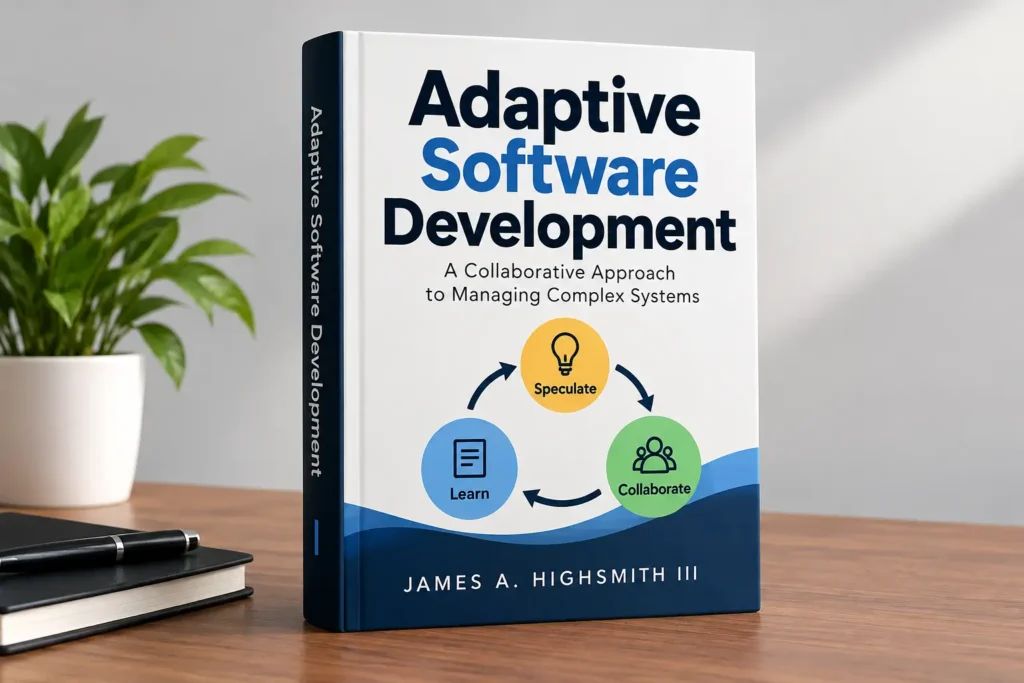
One of the key references for the methodology is Jim Highsmith’s Adaptive Software Development: A Collaborative Approach to Managing Complex Systems.
The book was originally published in 2000 and focuses on managing software projects where change, uncertainty, collaboration, and complexity are central concerns.
Its contents include topics such as:
- The adaptive development model
- Speculate
- Collaborate
- Learn
- Adaptive development cycles
- Collaboration
- Learning
- Complex environments
The book remains useful for readers who want to study the methodology beyond a short online definition.
Frequently Asked Questions
What is adaptive software development?
Adaptive Software Development is an Agile methodology designed for software projects with changing requirements and uncertainty. It uses a repeating cycle of Speculate, Collaborate, and Learn to help teams adapt as they gain new information.
What does ASD stand for?
ASD stands for Adaptive Software Development.
Is adaptive software development the same as Agile?
No. ASD is an Agile methodology, while Agile is the broader approach based on values and principles for adaptive software development.
What are the three phases of ASD?
The three phases are Speculate, Collaborate, and Learn. They form a repeating cycle that helps teams plan, build, review, and adapt.
Who created Adaptive Software Development?
Adaptive Software Development grew from the work of Jim Highsmith and Sam Bayer on rapid application development practices during the 1990s.
What is an example of Adaptive Software Development?
A startup building a new application can use ASD by setting an initial product direction, developing an early version, collecting customer feedback, and changing future development based on what it learns.
What are the main benefits of ASD?
The main benefits include better adaptation to changing requirements, stronger collaboration, continuous learning, frequent feedback, and reduced risk of following incorrect assumptions for too long.
What are the disadvantages of ASD?
ASD can require strong collaboration, frequent feedback, experienced teams, and flexible planning. It can also be challenging when requirements must remain highly fixed.
What is adaptive software development in software engineering?
In software engineering, ASD is an iterative approach for developing software in uncertain environments. Teams use repeated development and learning cycles to refine requirements, solutions, and plans.
What is the difference between ASD and Waterfall?
Waterfall generally relies more heavily on sequential development and upfront planning. ASD expects uncertainty and uses repeated cycles of collaboration, learning, and adaptation.
What is the difference between ASD and Scrum?
ASD focuses on adaptation, collaboration, and learning through its Speculate-Collaborate-Learn cycle. Scrum is a defined Agile framework with roles, events, and artifacts for managing iterative product development.
What is the difference between ASD and Kanban?
ASD focuses on adaptive development and learning in uncertain environments. Kanban focuses primarily on visualizing work, controlling work in progress, and improving workflow.
What is adaptive software development based on?
ASD is influenced by ideas related to complex adaptive systems, uncertainty, emergence, collaboration, and continuous adaptation.
Final Takeaway
Adaptive Software Development is an Agile methodology built for software projects where change and uncertainty are expected.
Its defining cycle is:
Speculate → Collaborate → Learn
Teams begin with a broad direction, work together to create software, learn from testing and feedback, and use those lessons to guide the next cycle.
That makes ASD particularly useful for complex projects where requirements, customer needs, and technical understanding can evolve over time.
The key idea is simple:
Do not assume you can know everything at the start. Build, learn, and adapt as the project becomes clearer.